
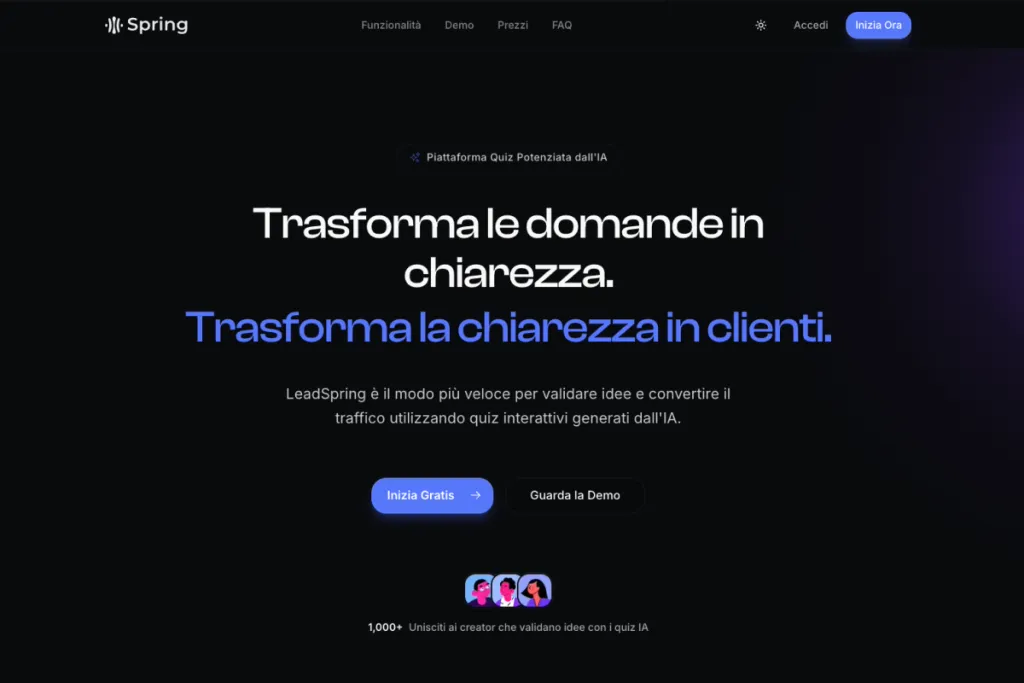
The problem
Founders, marketers, and product teams spend time and budget building things the market did not want, or converting traffic with static landing pages that collect no useful information about the visitor. Idea validation stays slow, expensive, and often not particularly rigorous.
LeadSpring was built to compress the time between "I have an idea" and "I know what my audience actually wants."
What we built
We built the platform from scratch. The application lets any user describe their goal in plain language (for example: "help users choose the right plan for my SaaS") and receive a complete interactive quiz in seconds, with conditional logic and personalized results.
Quiz generation happens through integration with language models, but users never see the complexity: the creation interface is clean and takes only a few clicks. Once published, a quiz can be shared via link or embedded on any website.
One of the most requested features was native multilingual support. The platform generates quizzes in over 50 languages without any extra configuration, which makes it useful for anyone reaching international audiences.
On the business side, we integrated Stripe to handle the three plans (Free, Pro, Business) with monthly billing, subscription management, and webhooks for updating user state. The infrastructure runs on AWS Amplify with Vercel for the Next.js frontend.
On the analytics side, the platform records every response, identifies patterns in the data, and allows XLSX export. Higher-tier plans include advanced segmentation and API access for integrating data into a CRM or marketing stack.
Where it is now
The platform is live with three pricing tiers, support for 50+ languages, and a growing community of creators and founders using it to validate ideas before building. Every quiz created with LeadSpring converts roughly three times more than a static landing page because it creates a dialogue with the visitor instead of presenting a monolithic page.